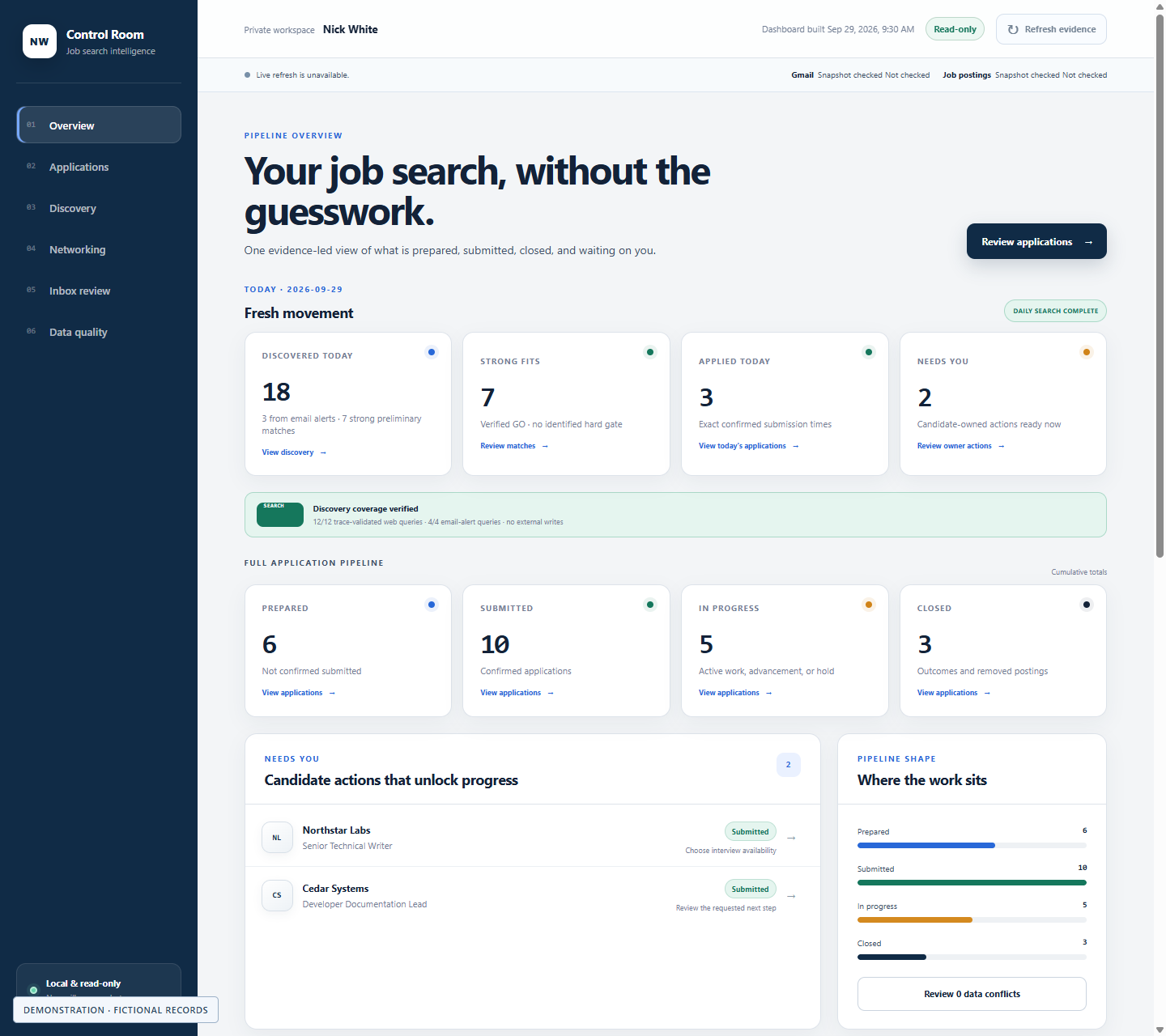
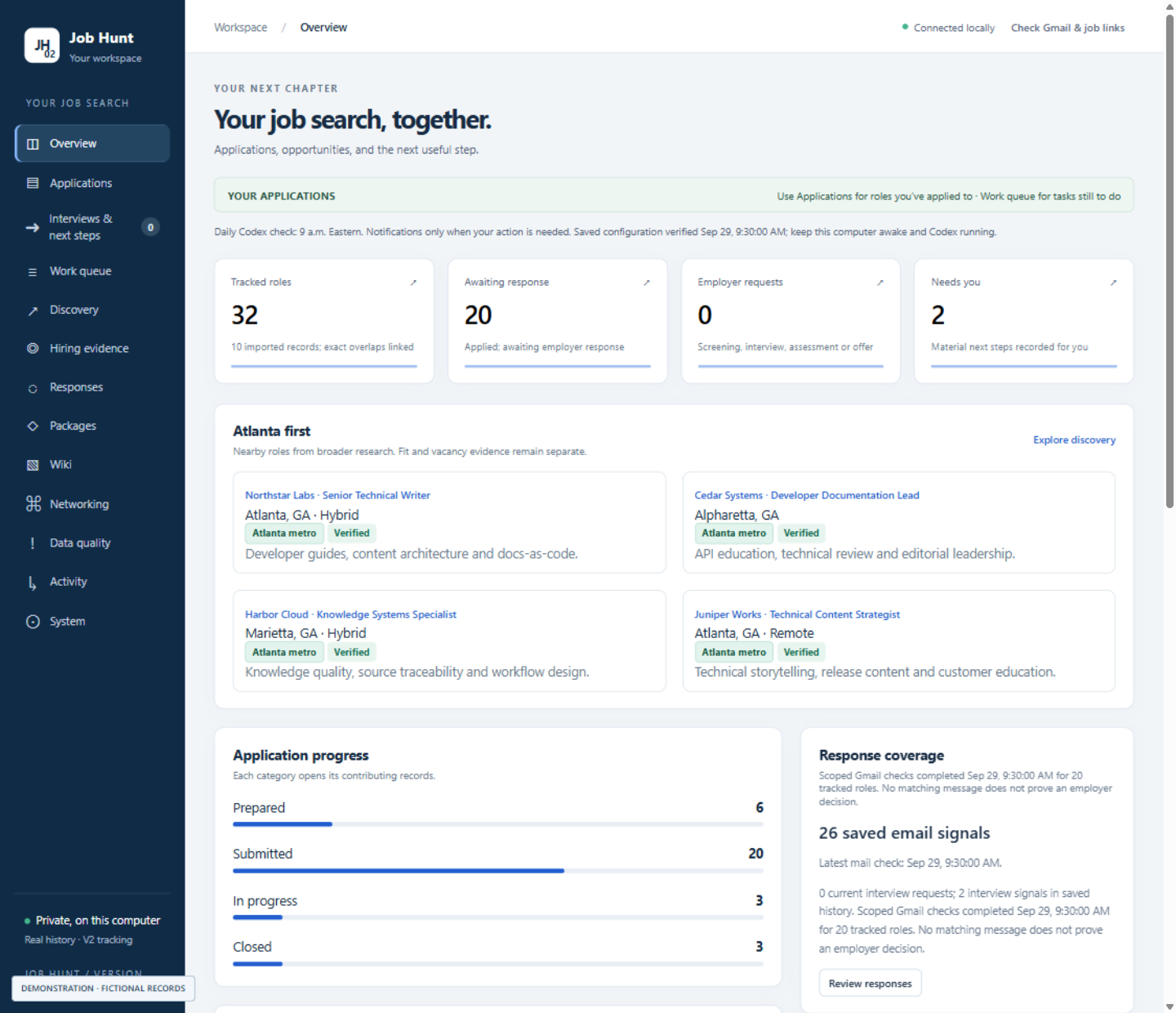
I built a local system for the work of finding a job: research roles, prepare truthful documents, coordinate applications, and follow employer responses. Job Hunt began as a Control Room for the records; V2 adds persistent coordination and recovery.
MY CONTRIBUTION
Problem framing, information model, workflow design, evaluation, and iteration. Built with AI coding assistance.
THE RESULT
Two generations of working dashboards, connected research and document workflows, and persistent records of applications, responses, and next actions.
THE INTERFACE / TWO GENERATIONS
From a control room to a coordinated workflow.
Real dashboard interfaces, populated with fictional records for this demonstration. Select an image to see it at full size.
01 / JOB HUNTControl Room
Make the records understandable. V1 brings research, document readiness, applications, and employer evidence into a single view. Its dashboard reads the underlying records and makes conflicts visible.
02 / JOB HUNT V2Workspace
Keep the work moving. V2 adds persistent tracking and coordination: who owns the work, which files were reviewed, what an attempt established, and what needs attention next.
WHAT THE SYSTEM DOES
The work around an application.
I designed the workflow around the complete search: discovering a role, checking its fit, preparing the right documents, carrying out an authorized application, and following the response. Each step leaves a record that the next step can inspect.
Find and assess roles
Requested searches combine public employer boards with broader web research. Leads, employer prospects, source coverage, and qualification review stay distinct.
Prepare supported documents
Career evidence guides tailored résumés. Editable DOCX and PDF files are rendered and reviewed, and the exact package version is retained.
Coordinate application work
The agent operates the employer’s application channel. V2 records ownership, attempts, uploaded-file evidence, and actual confirmation so interrupted work can be reconciled.
Follow responses and postings
Scoped checks review the authorized mailbox and saved job links. Employer requests, hiring decisions, posting availability, and source freshness have separate meanings.
Keep a useful working view
Searchable applications, packages, discovery, next actions, networking records, conflicts, and activity bring the work into one local dashboard.
Carry context forward
Persistent project memory and a source-linked career wiki retain decisions and lessons. The original facts and application records remain authoritative.
V1 → V2
What changed between versions.
V1 / RECONCILE
A common view of scattered evidence.
The Control Room projects existing research, application, package, mailbox, and posting records into an evidence-aware dashboard. I focused on clear status, source provenance, filters, and drill-down views.
V2 / COORDINATE
A durable record of the work itself.
V2 carries selected history forward into local SQLite stores, supports new tracking updates, and coordinates requested research and preparation. Attempt ownership and recovery rules keep an uncertain result visible until it is resolved.
The interfaces run locally. Browser application work is agent-assisted; the dashboard is not an unattended form-submission service. The public images and example below use invented records.
FICTIONAL WORKFLOW / NORTHSTAR LABS
What does “done” actually mean?
An illustration of the evidence model. These invented records do not submit an application or connect to a live system.
REVIEWED · NOT SUBMITTED
The file is ready. The application is not complete.
INPUT / OBSERVATION
A fictional résumé passes its claim and layout review.
A document review proves readiness. It provides no evidence of an employer receiving the application.
THE PROBLEM
What needed to change.
A promising role, a finished résumé, and a submitted application are three different things. When those states blur together, a dashboard can look productive while hiding unfinished work. The first version needed a way to reconcile records without turning assumptions into facts.
THE DECISIONS
01
Give each kind of evidence its own place.
The original Control Room keeps discovery, document readiness, application attempts, and employer outcomes separate. A removed posting does not become a rejection. A prepared file does not become a submission.
02
Make interrupted work recoverable.
V2 adds persistent work ownership and an explicit attempt history. A worker reserves an attempt before transmission. If the result is uncertain, the next action is reconciliation rather than an automatic second submission.
03
Review the exact file being used.
Candidate facts stay separate from generated prose. Packages are checked for supported claims and rendered layout; file hashes connect the reviewed document to the later attempt.
CURRENT STATE
What works today.
I use V2 for requested public-web and employer-board research, tailored DOCX/PDF preparation, agent-assisted applications, and response tracking. It retains imported history alongside new records and has recorded actual employer confirmations. Project memory and a source-linked career wiki help later tasks continue from earlier decisions.
Application work is agent-assisted; unattended form execution is not implemented. A separate daily check monitors the authorized mailbox for employer requests. This public demonstration uses fictional data and has no connection to the private job-search system.